Our product rankings are based on analysis of thousands of customer reviews, brand reputation, pricing trends, and popularity data. They represent our honest opinion and are intended as a helpful starting point for your research. Some links on this site are affiliate links — if you buy through them, we may earn a small commission at no extra cost to you. This helps us keep the site free and up to date.
High resolution 3D scanners pick up the fine detail that everyday scanners smooth over: the lettering on a coin, the knurling on a knob, the edge of a 2mm hole. The models here capture detail down to 0.02-0.05mm, so they suit makers copying small parts for a 3D printer, engineers doing reverse engineering, jewellers, miniature sculptors and anyone who wants a mesh that needs little clean-up.
Each scanner is listed with the point distance or precision from its maker's spec sheet. Need traceable measurements rather than sharp detail? See our high precision 3D scanners. Mostly scanning tiny items? Our 3D scanners for small objects narrow it down.


Every 3D scanner turns a surface into a cloud of measured points, then joins them into a mesh and finally a 3D model. The closer together those points sit, the smaller the feature the 3D scan can show. A scanner spacing them 0.2mm apart turns a 0.3mm engraved line into a soft dent; one at 0.02mm shows a crisp groove with straight walls.
That spacing is what makers mean by resolution, but spec sheets use three different words for related ideas, and they are not the same thing.
Also listed as "fused point distance", this is how finely the software can space the data once all the frames are merged. Revopoint quotes 0.02mm for the MINI 2 and 0.05mm for the POP 3 Plus. This is the figure that tells you how sharp edges, text and texture will look.
How consistently the scanner measures the same spot within one frame. A low figure means less noise, so fine surfaces come out smooth rather than grainy. The MIRACO is quoted at up to 0.02mm.
How close the measured size is to the real size. A 3D scanner can show beautiful surface texture and still be 0.1mm out over a 200mm part. If you are checking parts against a drawing, high accuracy matters more than sharpness - that is the job of high precision and metrology grade scanners, which are tested to standards such as VDI/VDE 2634. The UK's National Physical Laboratory explains how optical measurement systems are checked against traceable artefacts, and why calibration matters.
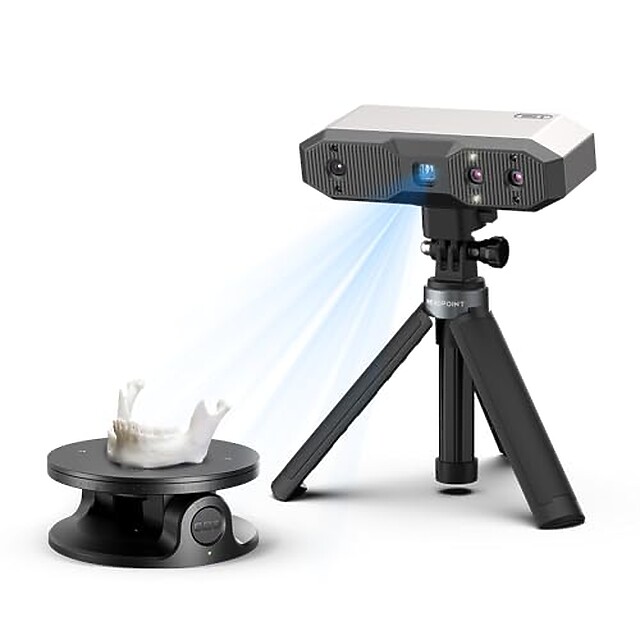
These figures come from each maker's own listing for the 3D scanners we stock. "Finest figure" is the point distance where one is given, otherwise the per-frame or accuracy figure.
| Scanner | Finest figure quoted | Light source | Working distance | Smallest object | Speed |
|---|---|---|---|---|---|
| Revopoint MINI 2 | 0.02mm spacing | Blue structured light | 120-250mm | 10mm | 16fps |
| Revopoint MIRACO | 0.02mm precision | IR, 4 cameras | 100-1000mm | 10mm | 15fps |
| 3DMakerPro Seal | 0.05mm (0.01mm accuracy) | Blue light | - | - | 10fps |
| EINSTAR Rockit | 0.05mm spacing | Blue laser lines + IR | 100-600mm | 5mm | up to 90fps |
| Revopoint POP 3 Plus | 0.05mm spacing | IR | 150-400mm | 20mm | 18fps |
| Creality Otter Lite | 0.05mm accuracy | IR + RGB camera | 100-200mm (close) | 20mm | 30fps |
| Creality Ferret Pro | 0.1mm accuracy | Structured light | up to 820mm | - | 30fps |
The pattern is clear: the sharpest models work close to the object and see a small patch at a time, which lets them hold complex geometry such as deep holes and sharp edges. The MINI 2 covers 168 x 132mm at its furthest distance, against 545 x 620mm for the Rockit's crossed lasers. Fine work and fast coverage pull in opposite directions, which is why the Ferret Pro, built for bigger items and quick capture, sits at 0.1mm. For whole cars or furniture, look at 3D scanners for large objects instead.
A useful rule of thumb is that the spacing should be well under the smallest feature you want to see - roughly a third to half its size. GoMeasure3D's broccoli test shows it well: Artec's Eva at 0.2mm lost the florets, the Artec Space Spider at 0.1mm showed them as dots, and the Artec Micro at 0.029mm showed each one clearly.
| What you scan | Smallest feature | Spacing to look for |
|---|---|---|
| Coins, jewellery, seals, tiny engravings | 0.1-0.3mm | 0.02-0.05mm |
| Miniatures and figurines for 3D printing | 0.2-0.5mm | 0.05mm |
| Small mechanical parts, clips, gears | 0.5-1mm | 0.05-0.1mm |
| Car parts, tools, helmets | 1-2mm | 0.1-0.2mm |
| People, furniture, bodywork | 2mm+ | 0.2-0.5mm |
Going finer than you need costs time: each scan gets slower, files get bigger and the computer works harder. If you mostly scan items bigger than a shoebox, an entry level 3D scanner at 0.1mm will give you clean results on a smaller budget.
A projector throws a coded pattern over the surface and two cameras read how it bends. Blue light has a short wavelength and is less affected by room lighting, so it gives the cleanest result on small, matt objects. The MINI 2 and Seal both work this way. See all structured light 3D scanners.
Several laser lines sweep the surface. A 3D laser scanner copes far better with dark, shiny and machined metal, and stays accurate over bigger parts, which is why most metrology scanners use lasers. They usually need tracking markers stuck on the object. Our blue laser 3D scanners include the Einstar Rockit, which also has a marker-free mode, and Creality's Sermoon and Pika pair blue lasers with NIR light.
Invisible NIR patterns are eye-safe, comfortable for scanning people and work without markers. Results are generally a step behind blue light, though the MIRACO's four-camera setup closes much of the gap.
Software such as Agisoft Metashape or RealityCapture builds a 3D model from hundreds of photos. With a macro lens, photogrammetry can show impressive surface texture, but measured size is less reliable and processing is slow.
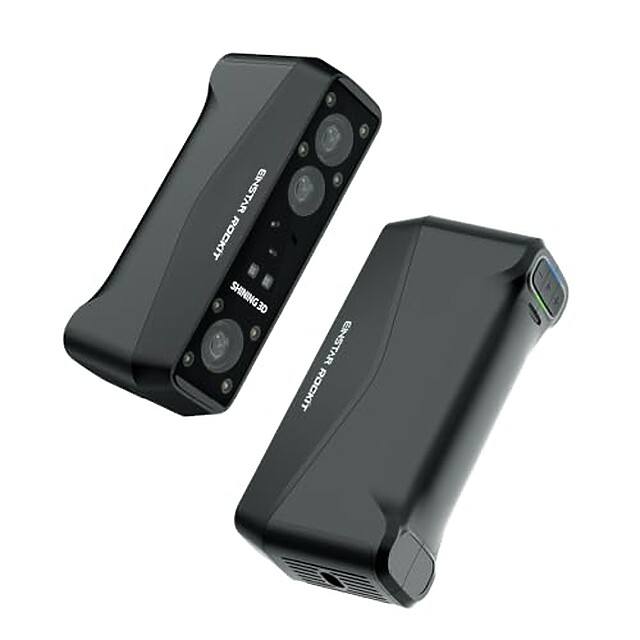
Most high detail models are now handheld: you move the scanner around a part on a turntable or walk it round a larger item. The MINI 2 weighs 175g and the POP 3 Plus 190g. Browse all handheld 3D scanners.
A desktop 3D scanner fixes the camera and turns the object for you, so every scan pass is repeatable. That suits batches of small parts, dental models and jewellery. Shining 3D's EinScan SP and the Artec Micro work this way; our desktop 3D scanners list the current options.
The MIRACO has its own processor, 16GB RAM and screen, so you can scan away from a PC. The Rockit runs from a swappable 5,500mAh battery for up to 3 hours over built-in Wi-Fi. See our portable 3D scanners for more.
The 3D scanners on this page are consumer and prosumer models. Above them sit two more tiers, and knowing where they start helps you judge price against need.
If your work ends in an inspection report for a customer, you need metrology grade. If it ends in a printed part or a digital archive, a consumer model is usually enough.
There is no official cut-off, but in practice a spacing of 0.05mm or finer. Most low-cost and body scanners sit at 0.1-0.5mm.
No. Resolution is how small a feature you can see; accuracy is how close the measured size is to the real size. An accurate 3D scanner is not always the sharpest, so check both figures.
Class 1 scanners are safe in normal use. Class 2, which includes the Rockit, relies on the natural blink reflex, so never stare into the beam. The UK Health Security Agency's laser radiation safety advice explains each class.
From our range, the MINI 2 for the finest spacing, the Seal for blue light on a tighter budget, and the Rockit if you scan dark or shiny metal. See also our wireless 3D scanners.
Manufacturer details: Revopoint MINI 2 specifications and 3DMakerPro Seal.